
Trade show booths are one of the key elements that help a company or brand stand out at a trade show. Designing an impressive and functional trade show booth plays a critical role in connecting with potential customers and increasing brand awareness. In this article, we will explore the basic steps of trade show booth design and the elements to consider.
Setting Goals and Clarifying the Project Scope
Before starting the trade show booth design, it is important to clearly define your goals. You can focus on the design process by determining what message you want to convey, your target audience, and the main purpose of your booth. Defining the project goal before starting the design increases process efficiency. The goal may be to acquire new customers, increase brand awareness, launch a product, or distribute samples.
Questions to ask when clarifying the goal:
- What is the main purpose of the booth at the exhibition?
- Which product/service will be in the spotlight?
- Who is the target visitor profile? (B2B, B2C, industry professionals, etc.)
- Which KPIs will be used to measure success? (Number of leads, QR registrations, number of meetings, etc.)
A strategic target plan guides the entire process, from determining the design language to the technology to be used.
Creating a Design Consistent with Brand Identity
Exhibition stand design should clearly reflect brand identity. The color palette, logo visibility, typography, slogan, and brand story should be conveyed to visitors within the first 3 seconds. Colors, logos, and the overall theme should reinforce your brand image and remind visitors of your brand.
A good exhibition stand design should offer a strong visual unity that ensures brand memorability in a crowded environment. Branded textures/materials, slogan boards supporting brand stories, product samples, and lighting harmony are particularly eye-catching.
Visual identity elements:
- The logo should be legible from at least three different angles.
- The brand color should be supported by lighting. Avoid shadows that reduce visibility.
- Slogans, product visuals, and messages on wall graphics should be understandable at a glance.
Functionality and Flow Planning
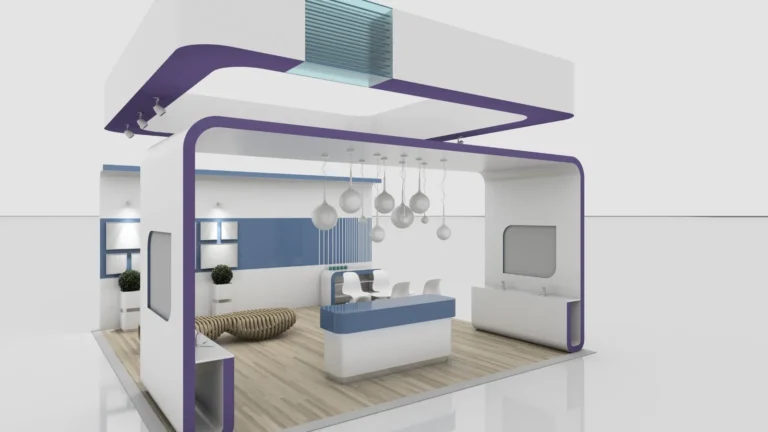
Design should be prepared not only for aesthetics but also with ease of use and visitor flow in mind. Stands that do not offer ease of movement and do not create a product experience cannot generate conversion, even if they attract attention. Consider the functional elements of your stand to showcase your products or services, create interactive areas, and connect with potential customers. Your booth design should offer an open space that invites visitors inside. Overcrowded or overly complex designs can reduce visitors’ desire to enter your booth.
How should the space be arranged?
- The product experience area should be close to the entrance.
- Meeting tables should be positioned in the background.
- Brochure, QR code, and catalog access areas should be positioned in a way that does not create congestion.
- Aisles should be 1-2 meters wide.
Eye-Catching Graphics and Content Usage
The average dwell time for visitors at trade shows is 6-12 seconds. Therefore, graphics, messages, and product presentations must be designed to be clear and striking. Visual appeal is crucial. The graphics used at your booth should be eye-catching and memorable.
Also, have a clear and effective message that clearly expresses your booth’s communication. The visual elements of your booth are important. Large and impressive visuals can be used to highlight your products or services. Clear and attractive graphics can be a great way to grab visitors’ attention.
Things to consider in graphic design:
- Prefer large typography and minimal text usage.
- Product USPs should be summarized in 3 points.
- LED screens can be used to display moving images.
- 4K videos help attract attention.
Space Optimization and Booth Size Planning
When designing your exhibition booth, consider the physical characteristics of the exhibition space. Evaluate the space in the best possible way, taking into account the location, size, and other factors of your booth. Create a layout that allows visitors to move around comfortably and explore your booth.
Space utilization is one of the most decisive factors in booth design. While vertical use is important in small spaces, creating experience corners in large spaces increases visitor interaction.
Tips for creating advantages in small spaces:
- Vertical display with raised shelves
- Folding table/chair system
- Minimal graphics, maximum message strategy
Event planning for large booths:
- Mini workshop area
- Demo screen + product testing area
- Networking seating corner
- QR menu board instead of printed materials
Enhance Interaction by Integrating Technology
Using technology in modern exhibition stand designs can offer visitors interactive experiences. Integrate technology into your stand using tablets, touch screens, or other digital tools.
Digital technology integration in modern exhibition stands enhances the visitor experience. Use elements that add interactivity to your stand. Screens, interactive games, product demonstrations, or digital content encourage visitors to show more interest in your stand.
Technologies that can be used in stand design:
- Tablet & kiosk information screens
- VR/AR product experience
- Touchscreen catalog screens
- Lead collection QR systems
- Digital card and CRM integration
This reduces follow-up costs after meeting visitors and increases the conversion rate.
Visitor Experience Design and Memorability
Exhibition stand design is not just a physical space, but the entirety of the visitor’s experience inside. Use information boards, brochures, and other materials to facilitate communication at your stand. By providing visitors with detailed information about your brand, you can increase your chances of attracting potential customers.
The atmosphere of your booth should offer visitors a sense of comfort and hospitality. Comfortable seating areas, beverage service, or a pleasant music selection can make your booth more appealing. In addition to good design, the team working at your booth is also important. With a well-trained team that has effective communication skills, you can interact with visitors and represent your brand correctly.
Some suggestions for a memorable trade show booth design:
- The reception team should be friendly and helpful.
- Presenters should use clear explanations rather than speaking quickly.
- Small gifts, product trials, and campaign cards increase recall rates.
Branded giveaways (notebooks, badges, QR code cards, samples) increase post-show recall and they positively impact post-exhibition conversions.
Sustainable Booth Design
Sustainability has become an important issue today. Using recyclable materials in your booth design can create a sustainable image.
In recent years, the use of environmentally friendly materials in exhibition stands has been a rising trend. Recyclable PVC, wood composites, and textile print surfaces are preferred.
You can make a sustainable choice by using a modular exhibition stand. Since the parts can be dismantled and reassembled at different exhibitions, both material waste is reduced and long-term cost advantages are provided. The modular structure can be scaled up or down as needed, graphic panels can be easily replaced, and it offers lower resource consumption during transportation.
Considering sustainability in trade show booth design:
- Strengthens brand image.
- Reduces carbon footprint.
- Modular construction lowers reuse costs.
Budget Planning and Implementation Process
Cost optimization is as critical a step as design. Cost items may include stand production materials, installation team, lighting and sound system, transportation logistics, and graphic prints.
Cost-saving options include:
- Choosing reusable modular panels
- Reducing printing costs by using digital catalogs
- Renewing graphic surfaces with textile material
- Choosing equipment with removable parts
Achieve Success in Exhibition Stand Design
First impressions are everything, especially at busy events like trade shows. By paying attention to these fundamental elements, you can turn your exhibition stand into an effective marketing tool and successfully introduce your brand to potential customers.
A successful trade show booth design involves goal setting, reflecting brand identity, functionality, eye-catching graphics, space optimization, and technology integration. By considering these factors, you can ensure your company stands out at trade shows.
Contact us to learn more about trade show booth design and discover our custom designs for your company. Let’s bring to life impressive and functional trade show booths tailored to your needs!
FAQ About Exhibition Stand Design
How long does it take to prepare an exhibition stand design?
It varies between 2-6 weeks, including concept, design, production, and installation. The time may be shorter for modular systems.
What are the most preferred materials in exhibition stand design?
Wood, MDF, composite, textile tension systems, aluminum profiles, and LED lighting elements are frequently used.
Can small square meter stands be eye-catching?
Yes. Vertical design, strong lighting, and a minimal message strategy can attract high interest.
Is it necessary to use technology in trade show booth design?
It is not mandatory, but tools such as VR, QR, and screen presentations significantly increase interaction.
Is booth design or location more important?
Both are effective. Location drives traffic, design creates conversion. Success increases when they are planned together.