
Participating in trade shows is a powerful step toward increasing brand visibility, connecting with potential customers one-on-one, and creating sales opportunities. However, standing out in a competitive environment requires more than just showing up, it requires a well-planned trade show booth optimization strategy. When optimizing your trade show booth, you may need to align your design, visitor experience, and messaging strategies. In this article, we detail how you can optimize your trade show booth.
Define Your Target Audience and Design Your Booth Accordingly
Clarify your goals for attending trade shows. Define your target audience and design your booth specifically for them. Rather than trying to please everyone, it may be more effective to appeal to a specific audience.
Is your purpose for participating in the trade show sales-oriented, brand awareness, or a new launch promotion? When the goal is clear, trade booth design, team messaging, and promotions come together around a single strategy.
Things to consider when determining the trade show target audience:
- A single target audience does not mean a single message. Micro-messages can be created for different segments within the same booth.
- Instead of a “general presentation,” segment-specific slides or content can be used on screens and in digital catalogs.
- Small meeting areas reserved for VIP customers increase the conversion rate.
Choosing the Right Location for Your Trade Show Booth
Choosing the right location for your booth directly impacts visitor numbers and brand visibility. Budget, target audience, and the flow of the exhibition space should be considered together.
Each area, such as the main entrance, back corridor, and intermediate passage point, has its advantages and disadvantages:
- Entrance areas have high traffic but are costly.
- Side corridors are more economical and can be compensated for with strong visual work.
- The target customer profile and trade show budget should be evaluated together.
Prioritize Visual Appeal and Booth Design
Color, lighting, and layout influence visitor decisions within seconds. A booth that fails to capture attention may go unnoticed.
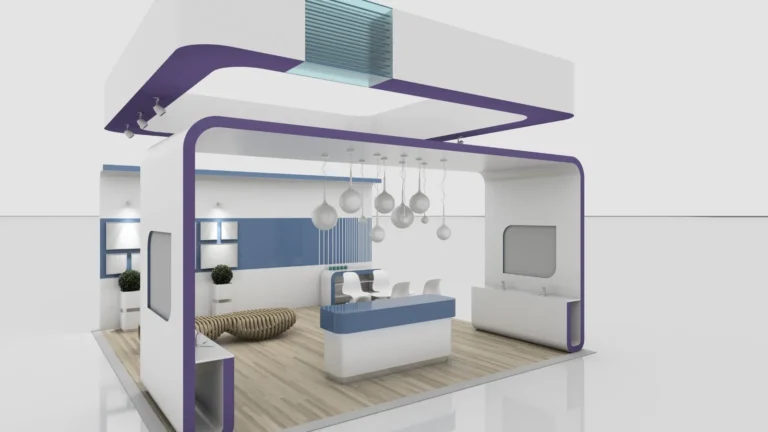
Your exhibition booth should reflect your brand image and attract visitors. A sophisticated design, eye-catching colors, and informative visuals can clearly convey your booth’s message. It is important to carefully consider your design to draw visitors in and keep them interested for a long time.
Color harmony, lighting, and the overall layout of the booth are important. Use creative and original designs to make your booth memorable.
Booth design suggestions:
- 3D brand elements and elevated logos increase visibility from a distance.
- LED screens are more eye-catching than static prints. Display product advantages in a loop.
- Warm lighting creates a sense of comfort, while cool tones are more suitable for technology brands.
- Locations near entrance areas generate high traffic but competition is intense. If you are in an interior space, an eye-catching ceiling hanging and floor directional graphics can guide visitors to your booth.
Offer Interactive Experiences
People remember not only what they see, but also what they touch and experience. Creating experiential areas at trade shows, instead of passive visual presentations, increases conversion. Attract visitors to your booth by providing interactive experiences. For example, you can capture visitors’ attention by organizing interactive games, product demonstrations, or digital events.
Engaging with visitors is key to making the trade show experience memorable. You can get participants to interact with your booth by adding compelling experiences. This not only provides an engaging experience but also allows you to establish a more personal connection with your potential customers.
On the other hand, demo durations should be between 60-120 seconds. Longer durations may result in a decrease in visitor flow.
Examples of interactions that can be used in trade show booth optimization:
- VR/AR product trial areas
- Touch-screen product catalog
- Mini workshop or demo session times
- Mini competitions and scoreboard
Use Social Media Actively
Trade show booth optimization continues not only on-site but also digitally. Use social media effectively during the trade show. You can increase engagement by attracting online participants with hashtags, instant updates, and social media contests.
Before the trade show:
- Create a LinkedIn event announcement.
- Prepare VIP invitation emails.
- Build excitement with teasers such as, “We have a surprise for those who visit our booth.”
During the trade show:
- Share booth-tagged reels/videos.
- Provide a catalog download area with a QR code.
- Offer a social media check-in gift.
After the trade show:
- Send thank-you emails to participants.
- Send demo request forms.
- Provide the sales team with a hot-cold lead separation report.
Present Content That Puts Information and Innovation at the Center
The content you present at your trade show booth should be informative and innovative. You can increase your credibility by informing your customers about the latest developments in the industry and highlighting the key features of your products.
Your booth should not only be visually appealing but also create an impression of knowledge and trust.
Some suggestions for improving your content:
- Digital catalogs with QR codes are both modern and sustainable alternatives to brochures.
- Present product advantages in a problem-solution format.
- Use numerical data: “30% energy savings,” “3 times faster processing time,” etc.
Train Your Booth Team on Trade Show Language and Behavior
The success of your booth depends on your team’s skills. It is important that your staff is knowledgeable about your products or services and shows genuine interest in visitors.
Train your staff well on your products or services and help them develop interactive communication skills. A trained, professional, and effective booth team inspires confidence in your visitors and represents your brand more effectively. Teams that smile, ask questions, and provide accurate guidance build trust with customers.
Training for the booth team can be structured as follows:
- The opening line should be ready: “Which solution were you looking into?”
- A CRM form focused on data collection, not card collection, should be used.
- A 30-second pitch should be prepared for a quick demo presentation.
Offer Memorable Promotions and Strategic Gifts
Offer visitors special promotions or gifts to remind them of your booth. You can use logoed products or special discount coupons to increase brand awareness.
It is important to give the right gift to the right person. Prioritize quality giveaways for high-value prospects.
Promotional suggestions for trade show booths:
- Choose useful products instead of classics such as USB sticks and notebooks.
- Gifts can be given not only to those who visit the booth but also to those who download the catalog via QR code.
- Mini raffles increase lead collection rates.
Data Collection and Measurement Methods at Trade Show Booths
Knowing the number of visitors throughout the trade show is an important starting point, but it is not sufficient on its own. True success is measured by the ability to connect the contacts made at the trade show to the sales process. Therefore, it is essential to collect both quantitative and qualitative data.
Tools and methods that can be used for accurate measurement:
- Lead capture tablet forms: The booth team can quickly enter contact information and transfer potential customer data directly to CRM (e.g., HubSpot, Salesforce).
- NFC/QR card scanning systems: Visitors can quickly register by scanning their cards; this also allows analysis of which product areas attract the most interest.
- Heatmap visitor density cameras: Visitor density, dwell times, and flow movements are tracked. It is possible to clearly measure which areas attract the most attention.
- Post-event ROI analysis tables: The sales closure rates of collected leads are compared to the cost of the trade show. This enables more informed decisions for the next trade show planning.
These methods ensure the seamless transfer of trade show data into the sales pipeline, making the return on investment visible.
Develop Post-Trade Show Follow-Up Strategies
Communication with visitors does not end when the trade show is over; on the contrary, the real conversion begins at that stage. Proper processing of the collected data converts potential into actual sales.
Recommendations for post-trade show communication:
- Campaigns that encourage visitors to join the email list (giveaways, special discounts, etc.)
- Sharing digital brochures and product guides
- Personalized communication flows tailored to different segments
- If this process is not implemented, the budget, and effort invested during the trade show may be lost.
You can create a 7-day plan for the post-trade show period as follows:
| Day | Action |
| 1–2 | Send a thank-you email + share content link |
| 3–4 | Offer a demo or product presentation |
| 5–6 | Segment leads using CRM scoring (identify hot leads) |
| 7 | Direct phone/Zoom contact by the sales team |
FAQ About Trade Show Booth Optimization
What is trade show booth optimization?
It is planning the booth to maximize efficiency in terms of design, communication, visitor experience, and sales processes.
What data should be focused on at a trade show booth?
Metrics such as visitor count, lead generation rate, demo conversions, and post-sales communication efficiency should be tracked.
How important is social media at trade shows?
Strategic sharing before, during, and after the trade show increases brand visibility and boosts booth traffic.
Do promotional products increase conversion at trade shows?
Promotional gifts presented to the right person with the right concept significantly increase brand recall.